In response to Kim's post about Frued, found here:
http://kimsartandphlilosophyblog.blogspot.com/2011/02/art-as-communication-using-freuds-view.html?showComment=1298494752680#c5748496592258441370
I think that with respect to Frued's belief's within art, there is more to the concept of releasing repressed motions than he lets on to or even understood himself.
The primary reason I bring this up is that repressed emotion very specifically does not have to be a bad thing. An artistic person may experience something that derives good or bad emotions within them to which they can focus into the creation of a happy image. The thing that makes this most interesting is that to the artist this may be used simply as a cathartic exercise, but with the successful creation of the art it can be of monetary or even simply just emotional value to another human being.
I think that artists being unhappy people is a fairly strong stereotype about artists because the act and experience in creating art is so strong as a cathartic exercise. Typically I would say that the greater portion of morbid artists are artists that have expended to much into their work / focus too long on something that is very difficult to finish. The best example of this being someone who has writer's block; they cannot think of any new ideas and seem to have blown their creativity in the past until something triggers them to do what they are good at successfully again.
Wednesday, February 23, 2011

A Note About Our Frued Conversation
So to catch up my blogging from last week, I forgot to mention one of the things that I found most interesting about the conversations we had about Frued in class. The topic that I am reffering to is the one where we discussed the comunication and understanding of the subconcious in its relation to how it affects artists.
To catch up on the point that we were making, the discussion was suggesting that the artist must successfully tap into their subconcious to derive the best creative work they can create. To which once we had decided that this is indeed what Frued would say on the subject, we began to talk about how interesting the concept of tapping the subconcious in creation of a piece of work can be. The biggest point deriving from this concept was suggesting that if an artist must tap into his subconcious to create art, that the viewer of the artwork would be exposed and expected to derive meaning from the origin's subconcious. Thus, we concieved the possibility of artists being able to communicate on a seperate level from normal conversation, a level of subconcious thought so to speak.
This was the most interesting to me because I had never considered this possibility previously, and really enjoyed the concept of a secret language between the best of artists. When brought up in class, we initially shunned the idea, but I think that there is some merit here that we are not considering. The key feature to which would be the concept of analyzing art amongst peers. When looking at a work and discussing the meanings and other important information that can be derived from it, we are simply talking about exactly what the artist intended to communicate through his/her subconscious as according to our experiences through art. When really considered like this, I feel that the secret language is at work all the time and frequently goes unnoticed to the bystanders who consistently overlook it when not considering art. Thus in the end I feel that the secret language is more present that we would think and that it may be a key feature to deriving the true understanding of art.
How do you feel about this concept?
Tuesday, February 22, 2011
An Attempt to Define Art - Continued
Throughout the corse of this class I have been trying to piece together my own little theories about art here and there between my blogposts. After having created the image that I did to help explain my equation from the first week, I tried to help explain one of the variables used in the equation, thus this post is to help explain Inspiration, based roughly on how I thought of it when reading Tolstoy:

Tuesday, February 15, 2011
In Response to Davion
In response to Davions Post:
http://hartphilosophy.blogspot.com/2011/02/with-great-power-comes-great.html#comments
Interestingly enough, I would say that you are right about the fact that art can be one of the most influential things that humans as individuals can create. When it becomes a question of power though, the answer is substantially more difficult to come by. For I would be put in the position to say that Art is only as powerful as we let it become.
Now strangely enough, the thing that makes this conversation interesting is that I feel there is at least one other variable to attend to when considering the power of art. For when you think about it, if we were to assume that this sort of power can be derived from art, then there must be something that seperates one piece from another.
To me, the answer is all about the masses. The dangerous, powerful artist is the one that can create a piece of work that convey's the same emotion to the largest number of people. If an artist can create great pieces of work that influence masses of people to believe in and follow their ideals, then art would be just as strong as any other form of influential communication. This would be a scenario to which the use of art would be to much power for people to control. Once this has been determined though, would we consider things like advertising to be a similar threat?
Monday, January 31, 2011
Response to Kate's Post
Personally, I would argue that perception of what is art has very little to do with the limitations of what can be art. Rather, the perception of art is more similar to the idea of Aesthetics to me. For one who understands their personal aethetic value for something in conjunction to understanding the aesthetic potential of others around them is what leads to art.
Now that being a little bit much to take all at once, to simplify I would say that human's naturally understand what is art to them and to people around them, it is an instinct of sorts. When it comes down to analyzing a specific piece of work, if it cannot be understood then it is an error of communication of one of the two parties involved (either the creator or the observer). These types of errors are the loopholes that crack through society and create the problem of your questioning of your own perception of the whole.
Do you feel that this analysis of perception helps you to follow through with what your original intent of understanding art was?
Friday, January 28, 2011
Defining Art
Today in class we talked some more about a good means as to how we can properly define art. As it turns out we discussed the definition this time in the format of an equation, to which I thought was a particularly appealing idea, so I started working on what I think is my appropriate understanding of art and how it can be defined.
What I came up with was an extention of the equation that we had in class that I feel incoorperates all aspects that I think are necessary in properly describing what art is and why it is important. The equation accomplishes two things: it shows what art is, and also gives an interesting way to determine if art is valued amongst people of the art world, and it looks like this:
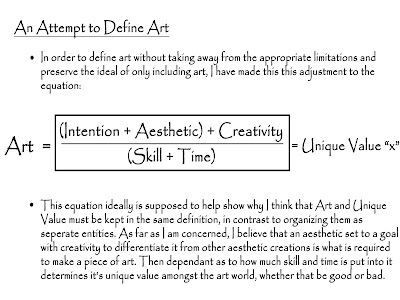
How do you feel that this equation does to define art? What differences do you think make it stronger or weaker?
What I came up with was an extention of the equation that we had in class that I feel incoorperates all aspects that I think are necessary in properly describing what art is and why it is important. The equation accomplishes two things: it shows what art is, and also gives an interesting way to determine if art is valued amongst people of the art world, and it looks like this:
How do you feel that this equation does to define art? What differences do you think make it stronger or weaker?
Thursday, January 27, 2011
Response to Andrea
To attempt to answer your question and touch on additional things that you mentioned in your post, I have two opinions.
First off, I'll try to answer your question, to which I think that the necessity to try and define art is more significant than it seems. Mostly because if we could come to some sort of concrete answer as to what art is and why, then lots of other things would become certainly much easier to answer by classification. Additionally, it is a frustrating thing to have a word that everyone in the world knows and understands, but can't be truly defined in a concrete manor. All in all, it would be nice if there were some sort of constant that we could agree on and attempt to hold against any formidable question.
Secondly, there is the string of comments that you left in your last paragraph, to which I think are very interesting. I think that the idea of philosopher's not defining words and ideas is incorrect; in fact I almost feel it’s the opposite. To my understanding, philosophy is a practice of unbiased understanding and proving of truth, to which defining art is a paramount example. To look at art philosophically is but to understand what art is and why it is significant to all things that it affects.
Do you still disagree?
Subscribe to:
Posts (Atom)
