Today in class we mentioned the currently indistinguishable difference between art created by people, and art that is beautiful of its own existence out in nature as to whether these things qualify as art itself. Interestingly enough, we mentioned that artists specifically try to immitate what we know as the world via the skills that they have in manipulating different mediums to accomplish this.
With both of these things having been mentioned, I feel that it is interesting to take note of people who have been studying computer graphics with the intention of making the artistic world that we view much more "beautiful" than our own real life could ever allow. As an example of this, consider all of the work that went into the movie Avatar, this level of artistic manipulation is stagering enough that many people can sit to watch this movie and feel like a part of the environment that has been laid out for them.
Considering this ideal of creating an artistically better world, is it possible that artists are working towards the idea of creating something along the same lines as The Matrix to keep people entertained? Are we going to eventually need to give up our reality with the ideal of art as its replacement to keep ourselves entertained?
What are your thoughts?
Monday, January 24, 2011

Friday, January 21, 2011
Art and Philosophy
Hey there everybody,
So I took the honors Nature of Human Nature class with David last year, and seeing as I enjoyed using this blog so much, I will continue my posts for the Art and Philosophy class this semester through this blog.
Please note that none of the posts previous to this one are relevent within the Art and Philosophy class, but if you are interested feel free to read through some.
Oh, and also, I put a new link on the places to go tab on the right side of the screen, I promise its not a virus, its just something interesting for you to keep busy with that i'll change with every post I put up, so be sure to come back and check it out.
Thanks, and hope for a good semester!
Alex
Saturday, June 5, 2010
Philosophical analysis of the Magic of Illusion
When spoken of, magic is usually blow off as a joke of sorts, that magic doesn't really exist. Well this is something I do not completely agree with, I think that magic comes in many more shapes and sizes than meets the untrained eye. The form of which takes the most simple disguise is that of Illusion.
The art of illusion works in a cryptic way depending on how it is being presented to the intended target. The magic itself is standing dangerously on the line between good and evil, for it is in key a magic of tricking the senses into believing something that they are not intended to.
Now back to the part where I mention that illusion is not commonly seen as magic. The use of illusion to simply trick the eyes of another human is quite literally that: a simple trick, so simple in fact that we usually enjoy the fun of trying to figure out what it is exactly that the magician is doing. However, there are much more complicated forms of this art that can be manipulated in an artistic and devious way. I refer to this style of illusion as dream weaving, for the artist is taking the skills of language and persuasion to weave an alternate reality for the listener. There are many forms of this, and all of which are distinctly different in their effect on the mind.
Dream Weaving within Lying
This is a skill that requires the user to issue another being constant belief in something that is not real. The more skilled the liar at remembering everything that has been altered from real existence, the more realistic the illusion becomes. There are two results of this, the beneficial outcome for the magician is that they have taken control of someone else's thoughts, and have the capability to alter reality in their favor when necessary. However, the unfortunate outcome to this use of alteration is that the magician is plagued with the memory of both realities, and these are more dangerous than one would anticipate. When the magician is weighed down to much by the pressure and stress of the brain on memories, it consumes them, and stress will lead to infinite outcomes of punishment to the user.
Dream Weaving within Fear
This is a more horrific skill. Those who become talented in the art of creating fear are truly using the capacity of dream weaving to its darkest purpose. The skill to create the illusion of true fear takes some of its own unique skills. As would be required, the user must have control over their intended target. Once this is established, the user takes that control and finds all of its weaknesses; the more talented the magician, the more things they can find to manipulate another. Then the most dangerous part, the user must give up their feeling of remorse towards any other person, for that remorse will lead to the failing of their illusion. At long last, this person is then prepared to do whatever is available to disturb their intended target. The benefit to this magician is that they have control over the person targeted, and all of their relations. However, the downside to the magician in this case is that they have nothing left to tie them down to reality, they are alone in the world and have forfeited their trust to their talent.
Saturday, May 15, 2010
Sunday, May 9, 2010
Onesis
As the last post that I am putting up for the class, I wanted to rewrite my theory of human nature on here in case anyone who may have had questions or comments could take them out on here. Also, I would like to point out that I am not done with this blog, when I think of other philosophical things in the future I will still post them here, so feel free to check back here every once in a while to keep your mind busy. Otherwise, thanks for participating :-)
Theory:
:: We exist for a comparatively short amount of time, and then we die.
:: We spend most of our life chaotically looking for answers about the world around us so that we can happily come to terms with what our life is supposed to be.
:: The path for coming to the complete understanding of these answers comes in three parts for those who are truly looking:
Part 1. Onesis
Onesis (Oh-knee-sis) is a term that I have made up to describe a path of coming to your own true self maturity; a sort of life epiphany, and this is what it looks like:
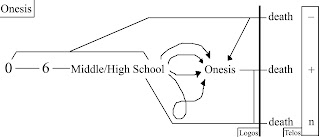
This path displays the timeline of an average person on their path to Onesis. I put the title "middle/high school" on the general age of about 17/18. This is the last part of the graph it is typically consistent between people, before the amount of time begins to change rapidly between how long it takes to get to the next step. The reason for this is that there is no way of telling exactly how long it will take you to reach Onesis, and as such, only you can come to this conclusion, for even though I am showing your the path, you are the only person who can discover what it really means.
When Onesis is understood, what you choose to do with it is up to you, as is represented by the break in the paths, and the symbols at the end of life, which stand for:
(+) Positive Influence, (-) Negative Influence, and (n) Neutral Influence... in Life.
These symbols also come with an analogy, where in life you choose to be the Coyote (negative), Sheep (neutral), or Sheepdog (positive).
Part 2. Logos
Logos is a word that stand for "word" and "reason", and it has a place on the path of life once Onesis has been understood. This part of life is when you have reached Onesis and you are left to choose what you want to do with the rest of your life (i.e. the Positive or Neutral path).
Logos is the second part because it represents what you do with Onesis once you understand it, and it is separated into its two parts:
:: The term "word" means that you come to understand the language in which you have most versed yourself in (i.e. music, science, art, etc.) and you slowly become more masterful in your capability to create and describe things using that "word".
:: The term "reason" represents the why in your life. Once you come to understand the "word" you are left to choose what you do with it, and reason is there to help you choose your influence on the rest of life.
Part 3. Telos
Telos is the final part of life, and literally means: "end, purpose", and "goal". This has been added to the path of life, because: "By understanding that which life consists of, we prepare ourselves for death".
Theory:
:: We exist for a comparatively short amount of time, and then we die.
:: We spend most of our life chaotically looking for answers about the world around us so that we can happily come to terms with what our life is supposed to be.
:: The path for coming to the complete understanding of these answers comes in three parts for those who are truly looking:
Part 1. Onesis
Onesis (Oh-knee-sis) is a term that I have made up to describe a path of coming to your own true self maturity; a sort of life epiphany, and this is what it looks like:

This path displays the timeline of an average person on their path to Onesis. I put the title "middle/high school" on the general age of about 17/18. This is the last part of the graph it is typically consistent between people, before the amount of time begins to change rapidly between how long it takes to get to the next step. The reason for this is that there is no way of telling exactly how long it will take you to reach Onesis, and as such, only you can come to this conclusion, for even though I am showing your the path, you are the only person who can discover what it really means.
When Onesis is understood, what you choose to do with it is up to you, as is represented by the break in the paths, and the symbols at the end of life, which stand for:
(+) Positive Influence, (-) Negative Influence, and (n) Neutral Influence... in Life.
These symbols also come with an analogy, where in life you choose to be the Coyote (negative), Sheep (neutral), or Sheepdog (positive).
Part 2. Logos
Logos is a word that stand for "word" and "reason", and it has a place on the path of life once Onesis has been understood. This part of life is when you have reached Onesis and you are left to choose what you want to do with the rest of your life (i.e. the Positive or Neutral path).
Logos is the second part because it represents what you do with Onesis once you understand it, and it is separated into its two parts:
:: The term "word" means that you come to understand the language in which you have most versed yourself in (i.e. music, science, art, etc.) and you slowly become more masterful in your capability to create and describe things using that "word".
:: The term "reason" represents the why in your life. Once you come to understand the "word" you are left to choose what you do with it, and reason is there to help you choose your influence on the rest of life.
Part 3. Telos
Telos is the final part of life, and literally means: "end, purpose", and "goal". This has been added to the path of life, because: "By understanding that which life consists of, we prepare ourselves for death".
In Response to Austin
I think that your question at the end here is very interesting for conversation.
Personally, I do not think that there will be a perfect world peace for people all across the world. My reasoning behind this is comes in a few parts.
First off, I don't think that there can possibly be a universal world peace simply because there are too many people out there who have anger in their life. The problem with this is that the many individual angry people contribute to overall anger, and when they find enough people to follow them, that is when worldly chaos happens.
Additionally, in my mind there is no single thing that could possibly bring everyone alive to come together and live life in harmony with each other. Plus, even if there was some singularly glorious thing that brought every single human being to the same bliss or world peace, there would be one major issue. The big problem would be that there is worldwide institutionalization; meaning that we are so embedded in the way of life that has already been set, and there are so many of us, that there would be no way of making that big a change happen.
As unfortunate as it sounds, I think that we are stuck here. But in the greater scheme of things, don't worry; because as it is right now there are still ways to find your own personal happiness, you just have to keep looking.
Subscribe to:
Posts (Atom)
